
 1-866-438-5442
 Heating & Cooling
 Water & Air Quality
 Home Security
 Commercial Solutions
 PROUDLY CANADIAN
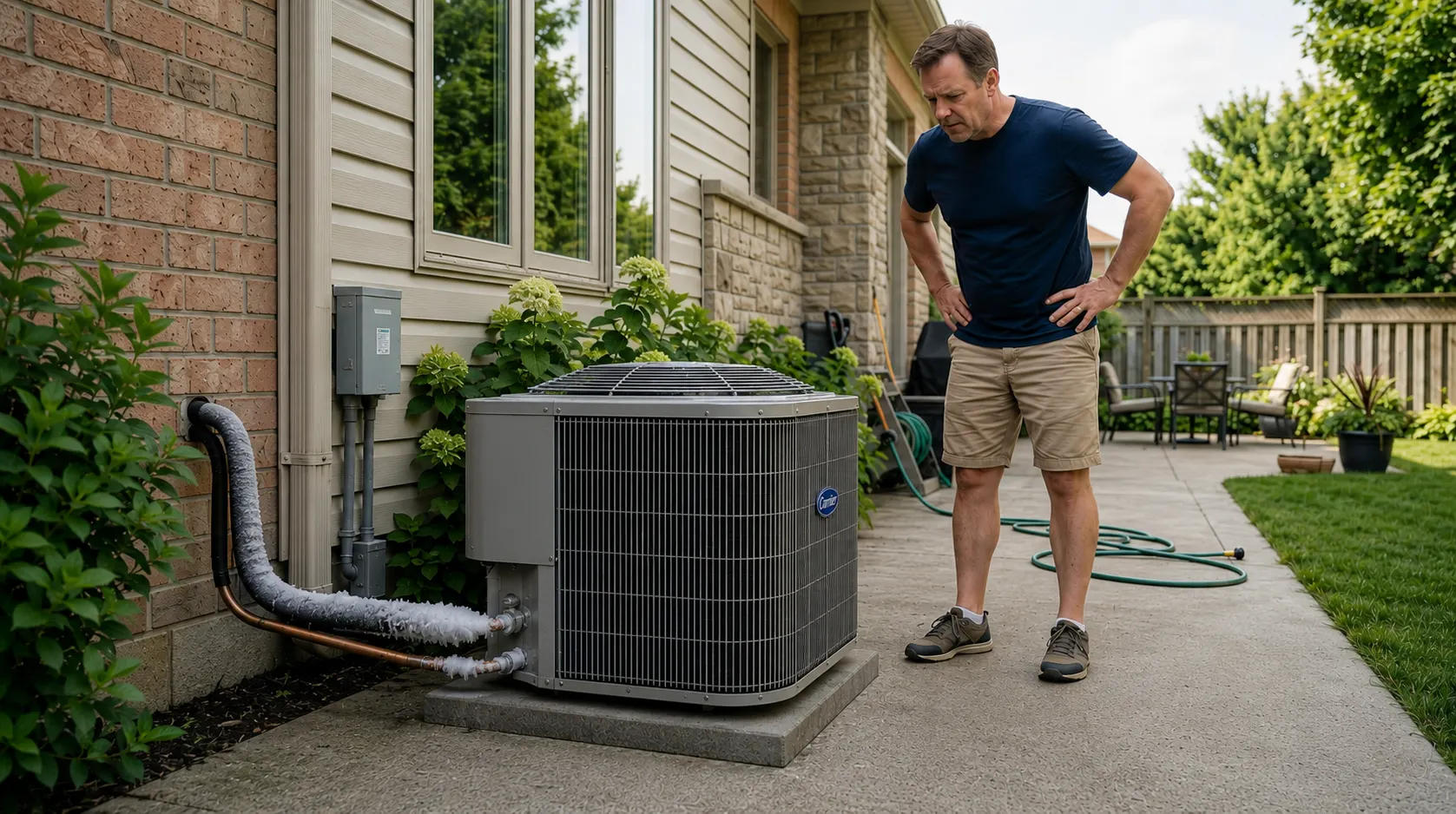

Table of Contents

If your AC is not working, the most common causes are thermostat issues, a clogged air filter, tripped breaker, frozen evaporator coils, refrigerant leaks, or faulty components. The quick solutions to these are: check your thermostat, replace the air filter, and reset the main switch. And if these solutions don’t work, contact a professional HVAC technician can identify the root cause.
Majority AC breakdowns in Ontario happen due to a few very common, mostly repairable problems that could be solved either by DIY solutions or when a pro technician inspects to locate where the problem is originating. This is a detailed guide that highlights the big reasons for the complete system failure and provides you with “what next?” in such confusing and troubling times.

Check These Basics Before Calling an Technician
When your AC is not working, make sure you go through this checklist before you contact a professional. It might surprise you how often one of these is the actual cause:
- Thermostat: Make sure the thermostat is set to “COOL” mode and the set temperature is lower than that of the room. Also, ensure that the batteries aren’t dead. A dead thermostat battery is one of the most overlooked causes, so check yours first.
- Air filter: A dirty, clogged air filter restricts airflow and can cause the system to shut down or the evaporator coil to freeze. Replace your air filter once it looks grey or matted, or at least every one to three months.
- Circuit breaker: Check the electrical panel. When the circuit breaker tripped. Reset it by flipping it fully to the OFF position and then back ON. And if this happens again, stop and do not attempt another reset because this is an electrical problem and you need a professional electrician.
- Outdoor unit: Walk out of your home and check whether the condenser fan is spinning. Ensure that the outdoor unit isn’t blocked by tall grass, dust, debris, or even dry leaves. For the unit to work efficiently, it needs to breathe. Maintain at least two feet of clearance on all sides for proper airflow.
- Vents: Make sure all the supply and return vents in the house are not blocked by curtains, furniture, or rugs.
When your AC was working fine until yesterday and today it just doesn’t – and none of the above-mentioned applies, there is a fair chance that a mechanical or electrical component has failed. Now that is something only a professional certified technician can handle.
Common Causes for AC When it’s Not Blowing Cold Air

This is one of the most common AC complaints from Ontario homeowners. Your AC may seem to run normally, but the air coming from the vents is not cold. Here is what could be triggering the problem:
| Cause | What It Means | Fix |
|---|---|---|
| Dirty air filter | Restricted airflow – coil can’t absorb heat properly | Replace the filter; run the system on fan-only for 1-2 hrs. if coil has iced |
| Low refrigerant | Leak in the system; refrigerant has escaped | Requires licensed tech – must locate and repair the leak, then recharge |
| Frozen evaporator coil | When ice forms, heat exchange is blocked. | Turn off the unit, let it defrost. Most likely happens due to a dirty filter or refrigerant leak. |
| Dirty condenser coils | Outdoor unit can’t release heat properly | Clean the outdoor coil every year. Spray water with a garden hose. |
| Malfunctioning capacitor | Compressor or fan motor won’t start | Replaced by a technician – quick, usually $200-$400 |
| Refrigerant overcharge | Too much refrigerant, also impairs cooling | Technician diagnosis required; excess must be removed |
AC won’t turn on at all
If the AC becomes completely unresponsive – no airflow, no sound, absolutely nothing – follow these steps in order:
- Check the thermostat: Check whether it is powered on and the display on. Change the batteries. And if the thermostat is completely unresponsive, consider replacing it with a new one.
- Check the breaker: When the breaker is tripped, it shuts off the AC completely. Try resetting it once, and if it trips again, do not attempt another reset. Call an HVAC technician instead.
- Disconnect Switch: Most outdoor AC units have a local disconnect switch, usually mounted on the wall nearby. Ensure if it is on or see if it’s accidentally turned off.
- Clogged drain line: There is a safety switch that turns off the system if the condensate drain pan fills up. Try using a wet-dry vacuum or vinegar flush to unclog the blockage and get it running again.
If the breaker switch trips repeatedly, don’t reset it again. Tripper tripping repeatedly points toward a motor failure, short circuit, or motor failure – these are some problems which can damage the system or cause a fire if left unaddressed.
AC Running but House Won’t Cool Down
Your system is running and you can hear the fan, but the indoor temperature refuses to drop to your set point. This is one of the more frustrating AC problems because it’s less obvious.
- The system is too small for space: An undersized AC will run constantly without ever reaching the target temperature on hot days. This is a sizing issue that requires either AC replacement or supplemental cooling.
- Overheating due to poor insulation: This happens when the doors and windows are not sealed properly, or when the insulation is not enough, or even when the AC is unable to tackle the heat load. Check for drafts around doors and windows, or feel whether walls are warmer than usual.
- Ductwork leaks: In central air systems, significant ductwork leakage means conditioned air is escaping into walls or attic space before reaching rooms. A duct inspection can quantify the loss.
- Low refrigerant: A slow leak means the system loses cooling capacity gradually. The AC runs longer to compensate but can’t quite get there.
- Dirty evaporator or condenser coils: Coil fouling reduces heat transfer efficiency. Annual maintenance addresses this before it becomes a comfort issue.
If your air conditioner completely stopped during hot weather, follow our emergency AC troubleshooting checklist.
What Different AC Noises Mean
| Noise | Likely Cause | Urgency |
|---|---|---|
| Clicking at startup/shutdown | Normal – thermostatic operation | None |
| Persistent clicking | Relay or control board issue | Call a technician |
| Banging or rattling | Loose component, debris in unit | Inspect outdoor unit; call tech if persistent |
| Piercing or shrieking | Worn belt or failing motor bearing | Turn off and call tech – motor damage risk |
| Hissing near refrigerant lines | Refrigerant leak | Call tech; do not run the system |
| Rippling or sputtering | Air in refrigerant lines or drain blockage | Call tech for diagnosis |
| Humming at outdoor unit (no start) | Failed start capacitor | Call tech – quick fix |
Reasons Why Your AC is Leaking Water
Water collecting around the indoor unit usually happens for one of two reasons:
- AC drain is clogged: Debris and algae frequently clog the drain line. You can clean it by pouring a vinegar solution down the pipe or using a wet-dry vacuum to get rid of the clogging.
- Evaporator coil ice melting: When the AC coil is frozen and you shut it off, the ice melts and it can overflow the drain pan. Once it completely melts, try finding out why it got frozen in the first place.
When the HVAC system starts collecting water around it, it can cause a number of problems like drywall, mold formation, or flooring issues. And if water has been pooling for more than a short while, shut down the air conditioner and contact a professional HVAC technician.
When you Stop Fixing AC by yourself and Call a Professional
Some AC problems are simple enough to handle yourself, like replacing a filter, clearing the drain line, cleaning around the outdoor unit, or swapping thermostat batteries. Everything else should be left to a licensed HVAC professional.
Contact a professional certified technician if:
- When your Air conditioner keeps tripping repeatedly
- When you hear hissing sounds, ice on lines, less cooling, this may indicate a refrigerant leak.
- When the outdoor compressor does not start.
- The AC Unit keeps turning on and off (short cycling).
- When you hear banging, grinding, or squealing sounds.
- Water has been pooling around the unit
- System keeps running but the goal temperature is never achieved.
Frequently Asked Questions For AC Not Cooling
01 Why is my AC running but not cooling the house?
This mainly happens when your air conditioner has a clogged filter, or if there is a refrigerant leak that lowers the cooling potential, dust wrapped evaporator or condenser coils, or an undersized unit that struggles during extreme heat during the cooling season. Begin with changing the filter, and if you still don’t see any improvement, contact a technician.
02 Why did my AC stop working suddenly?
AC shutting down unexpectedly usually happens due to a tripped breaker, a jammed drain causing the safety switch to trip, and sometimes even a bad capacitor could be the reason for a sudden shutdown. Check the breaker switch and the drain line, and if it does not restart and keeps tripping, contact a professional.
03 Can I run my AC if it’s frozen?
No, doing that is not recommended at all. When this happens, shut off the system at once. Keeping the system running while it is frozen harms the compressor. Put the system to “FAN ONLY” mode where the system would not cool. And let the coil melt the ice that’s there, which usually takes anywhere between 2 – 24 hours. When all the ice has melted, check out for the reason why the ice was forming and only then start using the AC.
04 How do I know if my AC has a refrigerant leak?
The common indicators of a refrigerant leak are warm air from vents even when the AC is running. Ice formation on indoor units, bubbling or hissing noises near the unit, and the utility bills (electricity) are higher than usual. It is recommended that only a licensed HVAC technician take care of the handling and recharging of refrigerants in Canada (mandatory by law, illegal to do on your own).
05 Why does my AC keep turning on and off quickly?
Repeated turning on and off also known as short cycling wherein the air conditioner powers on and off very quickly (more frequent and faster than usual), basically means a large system, dusty filter, low refrigerant level, or a malfunctioning compressor. These are some factors that strain the system a lot and drain the energy down the drain. It is recommended that you contact a professional to look at this so that he can fix the problem while it is a small issue before it becomes an expensive repair.

Don't miss our latest guides and updates.
Add LG Home Comfort as a Preferred Source on Google.


Table of Contents
Show More

Related Articles
Search Articles