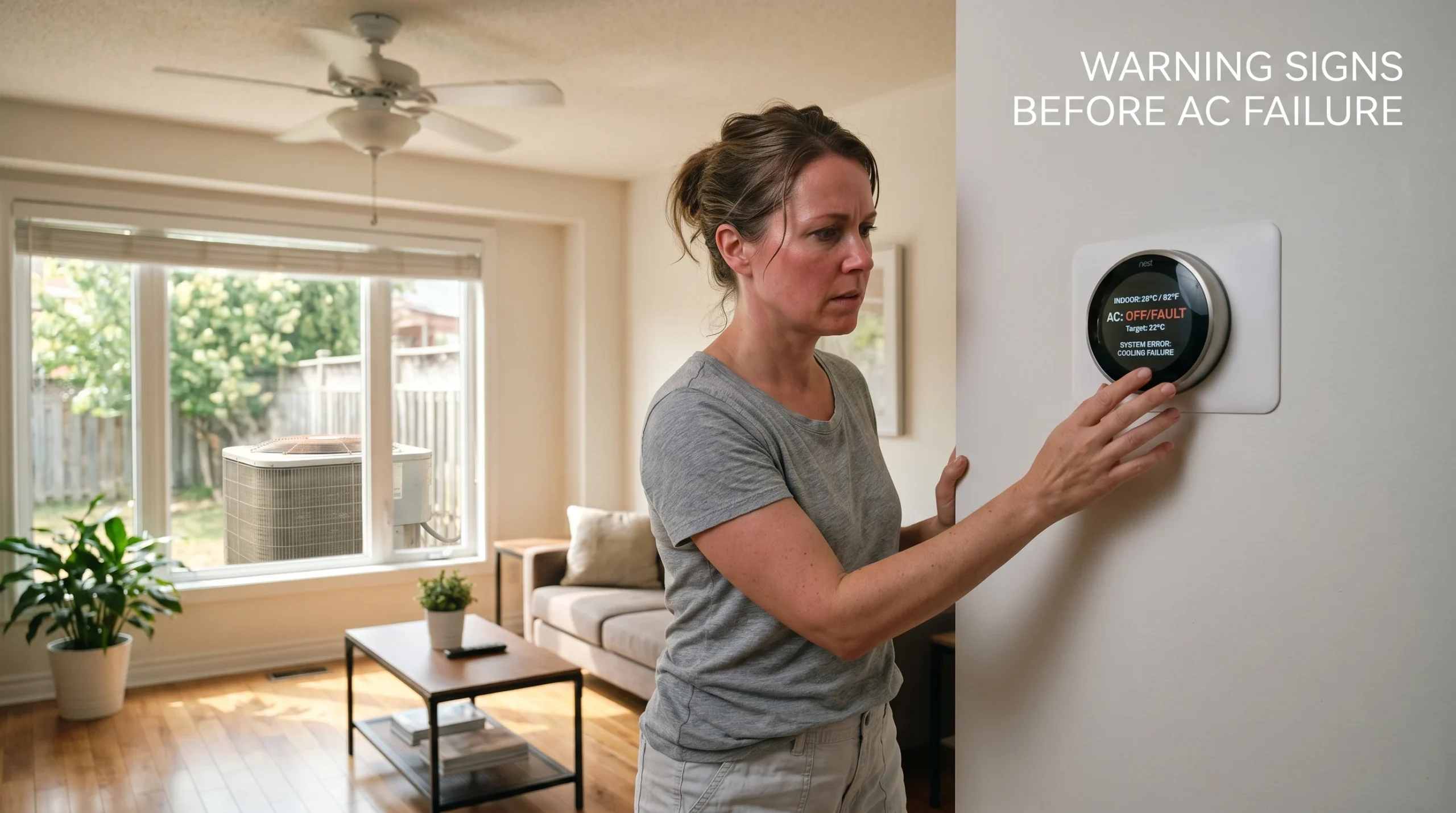
Common signs your air conditioner may need professional attention include warm air, unusual noises, weak airflow, short cycling, unexpectedly high electricity use, excess indoor humidity, water leaks, ice buildup, burning odours, or repeatedly tripping circuit breakers.
These symptoms can have different causes, so a qualified HVAC technician can assess the system, identify the underlying problem, and recommend the appropriate next steps. If you notice a burning odour or the circuit breaker repeatedly trips, turn the system off, do not keep resetting the breaker, and arrange professional service promptly.
Air conditioners may show warning signs before a failure, although some equipment problems can occur suddenly or with little warning. If your AC stops working during peak summer, service availability may be more limited during periods of high seasonal demand.
After-hours or emergency service may also be subject to different rates depending on the provider. Addressing developing issues earlier can help reduce the risk of additional equipment damage, a more extensive repair, or an unexpected system failure.
Here are 10 common AC warning signs Ontario homeowners may encounter, what they may indicate, and when professional assessment may be appropriate.
Sign 1: The air coming out of your vents isn’t cold
This is one of the clearest signs of a potential cooling problem. If your vents are blowing lukewarm air or your home is struggling to reach the thermostat setpoint, the system may need further evaluation.
Before arranging service, try two quick checks: confirm that the thermostat is set to Cool and that the cooling setpoint is below the current room temperature.
If the system is still not cooling properly, possible causes include low refrigerant charge or other refrigeration-system faults, dirty evaporator or condenser coils, restricted airflow, or compressor-related problems.
A low refrigerant charge can indicate a leak that requires professional diagnosis. These conditions should be diagnosed by a qualified HVAC technician and corrected as appropriate.
Sign 2: Your AC is making sounds it never used to make
A properly operating AC produces familiar sounds that can vary during startup and normal operation. You may already be used to your system’s baseline, including the hum of the outdoor unit or the rush of air through the vents.
However, a new, unusual, or persistent noise may be worth investigating, especially if it is accompanied by reduced cooling performance or abnormal system operation. Common sounds and their potential causes include:
Sound
Possible Cause
Banging or clanking
May indicate a loose or damaged component. If the sound is loud or persistent, turn the system off and arrange professional service.
Grinding
May indicate a problem involving a motor, bearing, fan, or another moving component. Turn the system off and arrange professional assessment if the sound is persistent or severe.
Squealing or screeching
May indicate a motor, bearing, fan, or other mechanical issue. The specific cause depends on the system configuration.
Repeated clicking
May indicate a problem involving a relay, contactor, control circuit, or repeated attempts by the equipment to start. Persistent or abnormal clicking should be professionally assessed.
Hissing
New, persistent, or pronounced hissing may indicate a refrigerant leak or another system problem and should be professionally assessed.
Rattling
May indicate loose panels, debris, or another mechanical issue within the system.
Bubbling or gurgling
May be related to refrigerant flow or condensate drainage. New, persistent, or unusual sounds should be professionally assessed.
When you hear the sound, do this: If the system develops a loud or persistent mechanical noise, such as banging or grinding, or produces repeated abnormal clicking, turn it off and arrange professional service. Continuing to operate equipment with a serious mechanical fault can increase the risk of additional equipment damage or a more extensive repair.
Brief startup, shutdown, or cycling sounds do not necessarily indicate a fault. If the sound is new, persistent, or accompanied by reduced cooling performance, arrange an assessment by a qualified HVAC technician.
Sign 3: Airflow feels weaker than it used to
If airflow feels weak or uneven, check the air filter and make sure vents are open and unobstructed. If the problem continues, possible causes include blower or fan problems, duct restrictions or leakage, disconnected ductwork, or restricted airflow across the evaporator coil. A qualified HVAC technician can assess the system and identify the cause.
Sign 4: The system keeps turning on and off every few minutes
During normal cooling, cycle length varies with weather, cooling demand, thermostat settings, system size, and the home itself. If your AC repeatedly runs for only a few minutes, shuts off, and starts again soon after, it may be short cycling.
Short cycling can prevent the system from reaching the set temperature, reduce humidity control, and increase the number of starts experienced by the compressor and associated electrical components. Common causes can include thermostat or control problems, oversized equipment, restricted airflow, electrical faults, or refrigeration-system problems.
If short cycling continues, have the system professionally assessed.
Sign 5: Your hydro bill is higher than it was this time last year
If your hydro bill is noticeably higher than the same period last summer, first compare electricity consumption as well as the total cost. Changes in weather, electricity rates, household energy use, and cooling demand can all affect the bill.
If electricity consumption has also increased without an obvious change in household use or cooling demand, AC-related factors such as dirty coils, restricted airflow, refrigeration-system problems, or malfunctioning components may be contributing.
An AC may still provide cooling while using more electricity than expected. If higher consumption cannot be explained by weather, household use, or other external factors, a qualified HVAC technician can check whether an AC-related problem is contributing.
Sign 6: The house feels humid even when the AC is running
An operating AC can provide both cooling and dehumidification when warm, humid air passes over an evaporator coil that is cold enough for moisture to condense from the air. As air moves across the coil, moisture condenses out of it, allowing the system to reduce indoor humidity while cooling the home.
If your house feels sticky or muggy while the AC is running, the system may not be providing adequate dehumidification and may warrant professional assessment.
Possible AC-related causes include short cycling, an oversized system, low refrigerant charge or other refrigeration-system faults, restricted airflow, a dirty evaporator coil, or other conditions affecting cooling and moisture removal.
Depending on the specific condition and its severity, these problems can affect cooling runtime, coil performance, airflow, or other factors involved in moisture removal.
During humid Ontario summers, persistently elevated indoor humidity can increase the likelihood of mould growth where moisture-sensitive materials and other favourable conditions are present.
It may be related to AC performance, but ventilation, air leakage, or other moisture sources in the home can also contribute and should be considered during assessment.
Sign 7: You’re seeing water or ice where there shouldn’t be any
Water pooling around the indoor unit or evaporator-coil area, or ice buildup on the indoor coil or insulated refrigerant line, can indicate an abnormal operating condition that requires further assessment.
Water around the indoor unit may result from a clogged condensate drain, an overflowing drain pan, a condensate pump problem, or moisture released as a frozen coil thaws.
A frozen evaporator coil can have several causes, including restricted airflow, low refrigerant charge or other refrigeration-system problems, and should be professionally assessed. For a deeper look at possible causes, see our guide on why your air conditioner is leaking water.
Water accumulation near the indoor unit can damage flooring, drywall, and ceilings. If you notice significant standing water or ice buildup, turn the system off and arrange prompt service. If water is near electrical components or controls, avoid touching the equipment until it has been professionally assessed.
Sign 8: Your AC Is Older and Repairs Are Becoming More Frequent or Costly
An aging air conditioner does not automatically need replacement. However, an older system may deserve closer assessment when age is accompanied by recurring faults, declining performance, increasing repair costs, or difficulty obtaining appropriate replacement parts.
A qualified HVAC technician can assess the system’s condition, identify the fault, and determine whether a repair is technically feasible. If replacement is being considered, the homeowner can then compare the expected repair cost, equipment condition, available replacement options, installation cost, efficiency ratings, and estimated operating costs before deciding how to proceed.
Efficiency ratings should also be compared carefully. Older equipment may have been rated using SEER, while applicable newer equipment may be rated using SEER2 under a revised test procedure.
The two ratings should not be treated as directly interchangeable. Actual energy use also depends on factors such as the home’s cooling load, equipment condition, installation, operating patterns, and electricity rates.
Ultimately, the repair-or-replace decision should consider age, equipment condition, repair history, performance, repair cost, parts availability, and replacement options, not age alone.
Sign 9: Burning smell from the vents or outdoor unit
A persistent or unexplained burning odour from your vents or outdoor unit should be addressed promptly. Possible causes include an overheating motor or electrical component, damaged wiring, or another electrical or mechanical fault.
Because some electrical faults can create a fire hazard, turn the system off and arrange professional assessment before restarting the equipment.
A qualified HVAC technician can inspect the HVAC equipment, while any regulated electrical work should be completed by appropriately qualified and authorized personnel.
If you see smoke, sparking, or flames, do not attempt to inspect or operate the system. Move to a safe location and contact emergency services if there is an active fire or immediate fire risk.
A musty or mouldy smell is different from a burning odour and may be associated with excess moisture, condensate or drainage problems, damp materials, or microbial growth. Persistent musty odours should also be investigated so the underlying moisture source or system condition can be identified and corrected.
Sign 10: The AC keeps tripping the circuit breaker
If your air conditioner trips its circuit breaker, do not ignore it. A breaker trip can indicate excessive current draw, an electrical fault, damaged wiring, or a problem with components such as the fan motor or compressor. If the breaker has been reset and trips again, stop operating the system and do not continue resetting it.
Repeatedly resetting a breaker that continues to trip does not correct the underlying fault and can increase the risk of equipment damage or an electrical safety issue.
A qualified HVAC technician can assess whether the problem originates within the air-conditioning equipment. If the issue involves the circuit breaker, electrical panel, branch-circuit wiring, or other regulated electrical work, that work should be completed by a Licensed Electrical Contractor or other appropriately authorized person in accordance with applicable Ontario requirements. For a broader troubleshooting checklist when your system will not respond, see what to do if your AC stops working in Ontario.
What Affects AC Repair Cost in Ontario?
AC repair costs can vary considerably depending on the underlying problem, the equipment involved, replacement parts, labour, accessibility, and the amount of diagnostic or repair work required.
Identifying a developing problem earlier may help reduce the risk of additional component damage or a more extensive repair, although the final cost depends on the specific fault and the condition of the system. Common AC service and repair scenarios include:
Scenario
What Can Affect the Cost
Capacitor replacement
Equipment type, capacitor specifications, and labour
Refrigerant leak diagnosis, repair, and recharge
Refrigerant type, leak location, repair complexity, and amount of refrigerant required
Evaporator coil cleaning
Coil accessibility, level of buildup, and service required
Blower motor replacement
Motor type, equipment compatibility, and labour
Compressor replacement
Compressor type, equipment, refrigerant-circuit work, and installation requirements
Full system replacement is not a standard repair and should be evaluated separately based on the condition of the existing equipment and the requirements of the home.
Actual costs vary depending on the equipment, parts, labour, accessibility, contractor, and scope of work. A professional diagnosis is usually required before an accurate repair estimate can be provided.
Addressing AC problems early may help reduce the risk of additional equipment damage and more extensive repairs. If replacement is being considered because of equipment condition, repair cost, parts availability, or recurring problems, explore our AC installation options.
If you are experiencing any of the warning signs above, arranging an assessment before peak cooling demand may help identify and address developing issues sooner.
Some AC problems provide warning signs before a failure, while others can occur with little or no warning. Changes such as unusual noises, higher electricity use, or reduced airflow may indicate that the system should be inspected.
Addressing developing AC problems promptly may help reduce the risk of additional equipment damage or more extensive repairs. However, the appropriate response depends on the underlying issue and the overall condition of the system.
Frequently Asked Questions
01 What information should I provide when booking an AC repair?
Describe the symptoms you have noticed, when they started, and whether the problem is constant or intermittent. Mention any unusual noises, odours, water leaks, ice buildup, or breaker trips you have observed. If the equipment model information is easily accessible, providing it along with details about recent maintenance or repairs can also help the service team understand the situation before the appointment.
02 How should I prepare my home for an AC repair appointment?
Make sure the technician has clear access to the thermostat, indoor HVAC equipment, electrical panel, and outdoor condenser where applicable. Move stored items away from the equipment and secure pets if necessary. You do not need to remove equipment panels or disassemble any part of the system before the technician arrives.
03 Can an AC problem be intermittent even if the system starts working again?
Yes. Some electrical, control, mechanical, or operating problems can occur intermittently before becoming more persistent. If the system has repeatedly stopped cooling, tripped a breaker, produced a burning odour, or developed another significant warning sign, professional assessment may still be appropriate even if it begins operating normally again.
04 Can one AC problem cause several warning signs at the same time?
Yes. A single underlying problem can sometimes produce several symptoms. For example, restricted airflow may contribute to weak airflow, reduced cooling performance, or evaporator coil icing. Because different faults can produce similar symptoms, a qualified HVAC technician can diagnose the system and identify the actual cause.
05 What AC maintenance can I safely do myself?
Homeowners can generally replace an accessible air filter, keep the area around the outdoor unit clear of leaves and debris, and check basic thermostat settings. Avoid removing equipment panels or attempting internal repairs. Refrigerant work, electrical diagnostics, capacitor or compressor work, and other internal equipment repairs should be handled by appropriately qualified professionals. If you are unsure whether a task can be performed safely, arrange professional service.
06 Does homeowners insurance cover AC repairs?
Coverage depends on the specific homeowners insurance policy and the cause of the damage. Repairs related to normal wear, gradual deterioration, maintenance, or mechanical breakdown may be excluded, while damage resulting from a covered sudden event may be eligible for coverage depending on the policy terms, exclusions, endorsements, and deductible.
If your air conditioner was damaged by a specific event, contact your insurance provider or broker and describe what occurred. They can confirm whether the loss is covered and what documentation or inspection may be required before repairs or replacement proceed.
Don't miss our latest guides and updates.
Add LG Home Comfort as a Preferred Source on Google.
No queues. No hold music. Submit your details and our team will reach out shortly to discuss your home comfort needs.
Submit this form and we'll call you back quickly. Please keep your phone nearby.
4.6★
Google Rating · 2,900+ reviews
100000+
Families Served
24/7
Customer Support Available
You're in the queue, there!
An advisor is preparing your callback. We'll dial you in:
Calling you in
3:00
Stay near your phone
We're calling
—
Make sure your phone is unlocked and not on Do Not Disturb.
Calling you now…
Your phone — should be ringing.
CONNECTING
Connecting You Now
We're opening your phone so you can speak directly with the right team.
Your phone dialer will open automatically.
Request Received
Thank You, there!
Thanks for contacting LG Home Comfort! One of our Home Comfort Advisors will be in touch with you shortly during our business hours. Mon–Fri: 8 AM–9 PM | Sat–Sun: 9 AM–7 PM

 1-866-438-5442

 Heating & Cooling
 Water & Air Quality
 Home Security
 Commercial Solutions
 PROUDLY CANADIAN