

 1-866-438-5442

 Heating & Cooling
 Water & Air Quality
 Home Security
 Commercial Solutions
 PROUDLY CANADIAN


Table of Contents

Quick Answer:
Canada has already phased out R-22 because it damages the ozone layer, and R-410A is being gradually phased down in favour of lower-global-warming-potential (GWP) refrigerants such as R-32 and R-454B. Existing R-410A systems can still be repaired and serviced, but refrigerant costs are rising, and replacement parts may become more expensive or harder to source over time.
Your air conditioner might be cooling your home perfectly today, but one refrigerant leak could turn a simple repair into a $2,000 decision. Many Ontario homes still rely on R-22 or R-410A systems, and changing refrigerant regulations are making repairs more expensive every year.
For homeowners, the biggest impact isn’t that your air conditioner will suddenly stop working. It’s that repair decisions are becoming more complicated. R-22 refrigerant is no longer produced in Canada, making it increasingly expensive and difficult to obtain. While R-410A remains available for servicing existing systems, Canada is transitioning new residential air conditioners to refrigerants with a lower environmental impact.
This guide explains why the R-22 and R-410A refrigerant phase-out is happening in Canada, what the transition timeline looks like, how it affects Ontario homeowners, which refrigerants are replacing them, and when it makes sense to repair or replace your air conditioning system.
What Is R-22, and Why Is It Being Phased Out?
R-22 is a hydrochlorofluorocarbon (HCFC) refrigerant used in air conditioners, heat pumps, and refrigeration systems. It was the standard refrigerant in Canadian residential HVAC equipment for decades.
The problem with R-22 is its environmental impact. When released into the atmosphere, R-22 eventually reaches the stratosphere, where ultraviolet (UV) radiation breaks down the refrigerant and releases chlorine atoms that contribute to ozone depletion. This layer protects the Earth from harmful UV rays.
It also has a high GWP of 1,810, meaning it is far more effective at trapping atmospheric heat than carbon dioxide. Chlorofluorocarbons (CFCs) and hydrochlorofluorocarbons (HCFCs), including R-22, contributed significantly to ozone depletion, leading to international agreements such as the Montreal Protocol.
The Canadian Phase-Out Timeline
| Year | Milestone |
|---|---|
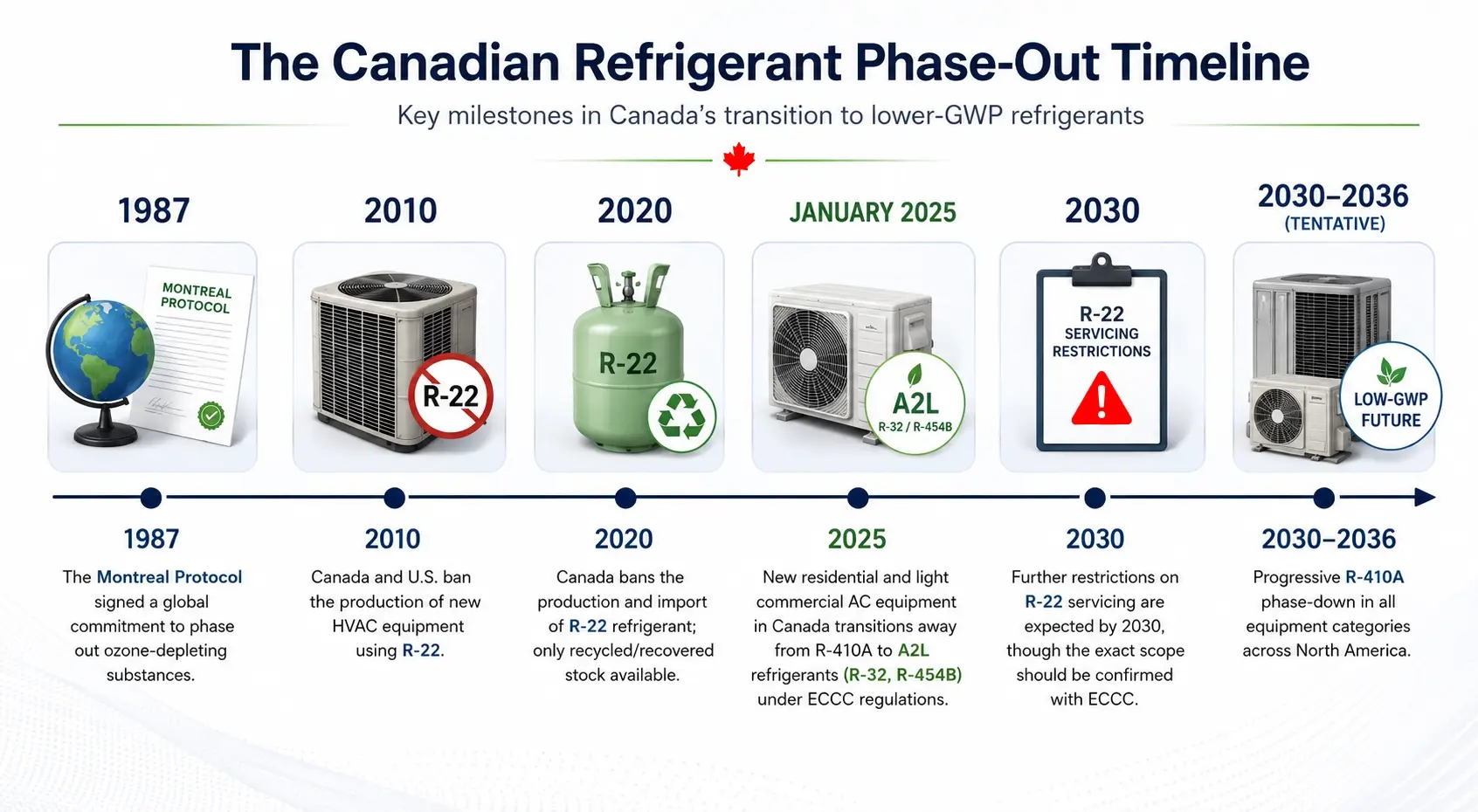
| 1987 | The Montreal Protocol was signed, establishing a global commitment to phase out ozone-depleting substances. |
| 2010 | Canada banned production of new HVAC equipment using R-22 |
| 2020 | Canada banned production and import of R-22 refrigerant; only recycled/recovered stock available. |
| January 2025 | Beginning in January 2025, new residential and light commercial AC equipment was required to transition toward A2L refrigerants under ECCC regulations. |
| 2030 | Further restrictions on R-22 servicing are expected by 2030, though the exact scope should be confirmed with ECCC. |
| 2030-2036 (tentative) | Progressive R-410A phase-down in all equipment categories across North America. |
Key takeaway for Ontario homeowners: R-22 is not yet illegal to use in an existing system. But it is illegal to produce or import, meaning only recovered/recycled stock is available at significantly higher prices. By 2030, all use of R-22 in Canada is prohibited.
What Does R-22 Phase-Out Mean for Your Wallet?
If your system leaks refrigerant, recharging it means purchasing refrigerant from a shrinking recycled supply at $100-$250 per pound or more. Under Canadian HVAC practice, technicians should not simply top up refrigerant without identifying and repairing the leak first.
A central air conditioner system typically holds 3-10 pounds of refrigerant, depending on its size. A significant leak on an older system can mean a service call that costs $500-$2,000 just for refrigerant, before any parts or labour.
Servicing these older systems requires certified HVAC technicians authorized to handle the work. In Ontario, this means a 313A or 313D Certificate of Qualification from Skilled Trades Ontario. Refrigerant handling also requires Ozone Depletion Prevention (ODP) certification where applicable under Ontario regulations.
It is illegal for uncertified individuals to handle refrigerants. Our Scarborough AC repair services include full refrigerant compliance. Only 313A or 313D-certified technicians handle refrigerants on our calls.
Isn’t R-410A the Safe Replacement?
R-410A replaced R-22 as the standard residential refrigerant starting in the mid-2000s. R-410A has zero ozone-depleting potential, which addresses a major environmental concern. But it introduced a different environmental issue: its GWP is 2,088, meaning it is more than 2,000 times more potent as a greenhouse gas than CO₂ over 100 years.
As a result, R-410A phase-down is being carried out under the Kigali Amendment to the Montreal Protocol, to which Canada is a signatory. According to Environment and Climate Change Canada (ECCC), the regulations include:
- New systems manufactured from January 2025: Residential and light commercial air conditioner and heat pump systems manufactured for the Canadian market predominantly use A2L refrigerants, primarily R-32 and R-454B, rather than R-410A
- Existing R-410A systems: Continue to be serviceable with R-410A for the foreseeable future. Supply is currently available, though prices will increase as the phase-down progresses.
- Long-term: A progressive phase-down through 2030-2036 will eventually restrict R-410A across all equipment categories
What this means for homeowners: if you purchased a new air conditioner or heat pump before 2025, it likely uses R-410A and will remain serviceable for years. However, availability may gradually decrease as production quotas are reduced. If you are purchasing new equipment in 2026 or later, it will almost certainly use an A2L refrigerant.
Refrigerant Comparison: R-22, R-410A, and Their Replacements
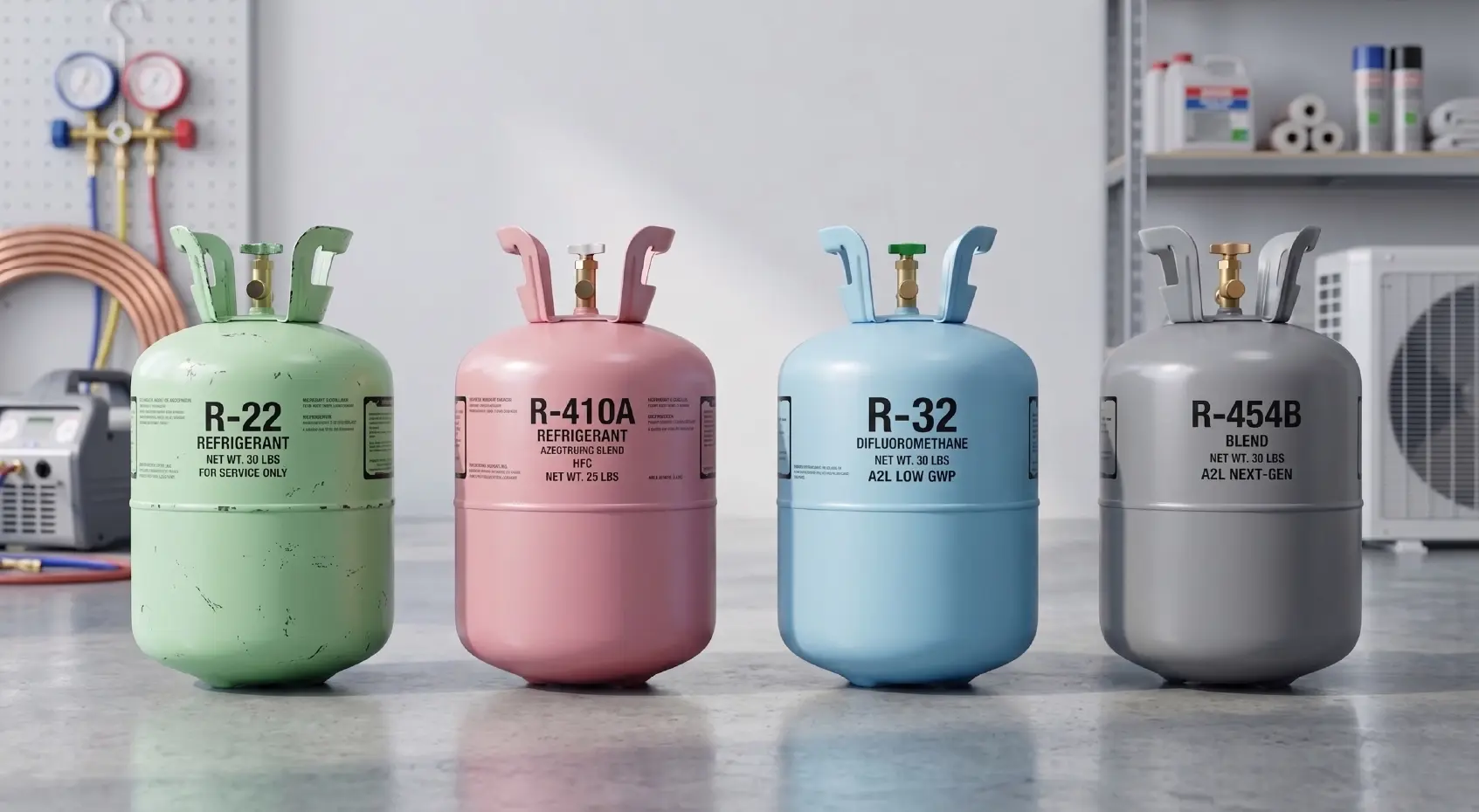
| Refrigerant | Type | GWP (100-year) | ODP | Flammability | Status in Canada |
|---|---|---|---|---|---|
| R-22 | HCFC | 1,810 | 0.055 | None | Banned from production/import since 2020 |
| R-410A | HFC | 2,088 | Zero | None | Phase-down for new equipment from 2025; existing systems still serviceable |
| R-32 | HFC | 675 | Zero | Mildly flammable (A2L) | Current primary replacement for residential AC in Canada |
| R-454B | HFO blend | 466 | Zero | Mildly flammable (A2L) | Common in new residential and light commercial equipment 2025+ |
| R-466A | HFO blend | 733 | Zero | Non-flammable | Commercial applications; adopted as A2L alternative* |
| R-290 | Hydrocarbon | 3 | Zero | Highly flammable (A3) | Limited residential HVAC use in Canada because of A3 flammability classification. |
*R-466A has very limited market adoption. It is not widely adopted in Canada.
What Is an A2L Refrigerant and Does It Affect You?
A2L is a safety classification for mildly flammable refrigerants. A2L refrigerants are defined by ASHRAE Standard 34 as having low burning velocity and low toxicity. They will only ignite under specific conditions of concentration, temperature, and ignition energy that are rarely encountered in a properly installed HVAC system.
Ontario residents with an A2L-refrigerant system may notice no practical day-to-day impact. You will not notice a difference in how your system runs. However, it does affect installation and service:
- Technicians must be trained and equipped to handle A2L refrigerants safely. Additional PPE and detection equipment may be required.
- A2L refrigerants have different safety requirements; installers must calculate the correct refrigerant charge for the size of your home and follow updated installation standards.
- Refrigerant leak detection is required in some commercial applications under updated CSA standards.
- Equipment must be specifically designed and approved for A2L refrigerants. You cannot simply put R-32 into a system designed for R-410A.
LG Home Comfort technicians are trained and equipped for A2L refrigerant handling. All equipment we install in 2026 and beyond uses A2L refrigerants where applicable.
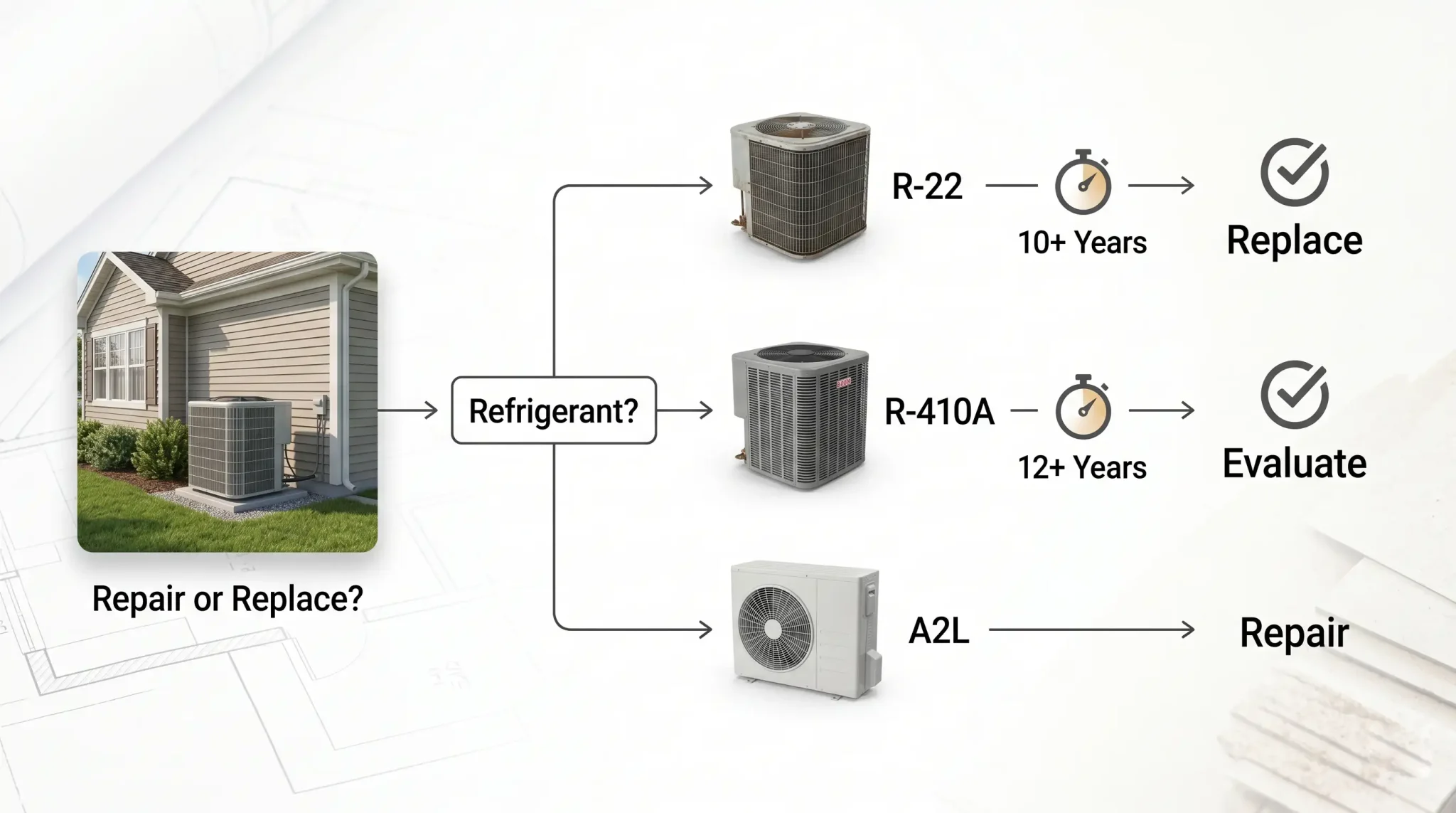
Should You Repair or Replace Your System?
| Scenario | Recommendation |
|---|---|
| R-22 system, under 10 years, minor leak | Repair if R-22 is available and cost-effective, but start planning for replacement. |
| R-22 system, over 12 years, any repair | Replace it. R-22 availability is declining, and the system is near the end of life regardless |
| R-22 system, major component failure | Replacing the compressor or coil on an aging R-22 system rarely makes financial sense. |
| R-410A system, under 10 years, minor repair | Repair it. R-410A remains serviceable; the system has years of useful life ahead |
| R-410A system, 12+ years, frequent repairs | Assess the repair expense vs. replacement; new A2L equipment is more efficient. |
| Any system, R-22 or R-410A, running well | Maintain annually; maximize the system’s remaining service life |
Based on LG Home Comfort’s experience servicing HVAC systems across Toronto, Hamilton, Ottawa, Mississauga, and surrounding Ontario communities, many homeowners are now choosing heat pumps instead of replacing aging R-22 systems because of available rebates and improved efficiency. Hamilton AC installation assessments from our team include an honest evaluation of whether your current refrigerant type and system age make repair or replacement the smarter financial decision.
How to Tell Which Refrigerant Your System Uses
The quickest way is to look at the data label on your outdoor condenser unit. It will state the refrigerant type. It is typically printed on or near the nameplate along with voltage and BTU capacity. Common label text:
- R-22: Typically found in systems installed before 2010; phase-out directly affects you
- R-410A: System is likely 2006-2024; currently serviceable; new equipment phase-down underway
- R-32, R-454B, or R-466A: System uses current A2L refrigerant; no immediate action needed
If the label is faded or missing, call a certified technician to inspect the system. Attempting to add the wrong refrigerant type can cause catastrophic equipment damage.
Ontario Rebates for Upgrading Your System
If the refrigerant phase-out is prompting you to consider a system upgrade, current Ontario programs can significantly offset the cost:
Ontario Home Renovation Savings (HRS) Program: Get a rebate for eligible cold-climate air-source heat pump installations.
Note: Standard central AC replacements (non-heat pump) do not currently qualify for the main HRS rebates. Heat pump installations that also provide cooling qualify. This makes the refrigerant transition an opportunity to consolidate heating and cooling into one rebate-eligible system.
Mississauga heat pump installation from LG Home Comfort includes full rebate eligibility confirmation and application support.
Why Choose LG Home Comfort for Your Refrigerant Upgrade?
- 313A or 313D-certified technicians: Every refrigerant-related service is performed by licensed technicians with 313A or 313D certification from Skilled Trades Ontario
- No New R-22 system installations: All new LG Home Comfort installations use current refrigerants
- A2L-ready: Our technicians are trained and equipped for R-32 and R-454B systems
- Rebate expertise: We confirm rebate eligibility and handle documentation as part of every eligible installation
- 24/7 emergency support: We prioritize emergency calls if your R-22 system fails mid-summer
- Transparent Pricing: Written, itemized quotes before work begins, with no surprise refrigerant charges.
- Trusted Across Ontario: For more than 10 years, LG Home Comfort has helped Ontario homeowners with professional HVAC installations, repairs, and system replacements.
For more on the environmental context behind these changes, see our guide on the shift to eco-friendly refrigerants in the HVAC industry. To book an inspection or get a quote for a system upgrade, contact our team or call 1-866-438-5442.
If you’re unsure whether your current system is worth repairing or replacing, schedule a professional refrigerant assessment with LG Home Comfort. We’ll identify your refrigerant type, explain your repair and replacement options, and help you make an informed decision; without pressure to replace equipment that still has years of reliable service left.
Frequently Asked Questions
01 Is it illegal to use R-22 in Ontario right now?
No, not yet. It is illegal to produce or import R-22 in Canada as of 2020, but its use in existing systems is still permitted. Only recycled and recovered R-22 stock can be used for service. By 2030, Canada will complete its total phase-out of HCFC imports under the Montreal Protocol.
02 How do I know if my air conditioner uses R-22 or R-410A?
Check the data label on your outdoor condensing unit. The refrigerant type is printed on the nameplate alongside the model number and electrical specifications. If the label is missing or unreadable, a licensed HVAC technician can identify the refrigerant type during an inspection. Never add refrigerant without confirming the type. Mixing refrigerants causes serious equipment damage.
03 Can I just top up my R-22 system to keep it running?
Technically, yes, if you can find and afford the recycled supply. Prices range from $100-$250 per pound, and supply is declining. More importantly, recharging the refrigerant without finding and repairing the leak is a temporary fix. A system more than 12 years old with a refrigerant leak is almost always a better candidate for replacement than repeated recharging.
04 Can I convert an R-22 system to R-410A?
No. R-410A operates at significantly higher pressures than R-22 and requires different components. An R-22 system cannot simply be recharged with R-410A. In most cases, replacing the system is the safest and most cost-effective solution.
05 What refrigerant will new air conditioners use in Canada?
New residential AC and heat pump equipment manufactured for the Canadian market from January 2025 predominantly uses A2L refrigerants, primarily R-32 and R-454B. These have a lower GWP than R-410A (R-32 is 675 GWP vs. R-410A’s 2,088) and zero ozone-depleting potential. They are classified as mildly flammable (A2L) but pose no practical risk to homeowners if properly installed.
06 Will my current R-410A system still be serviceable?
Yes, R-410A systems will remain serviceable for the foreseeable future. Industry experts expect R-410A to remain available for servicing existing systems throughout the HFC phase-down, although prices may gradually increase. However, availability may gradually decrease as production quotas are reduced. If your R-410A system is less than 10 years old and running well, replacement is not necessary. However, service costs may rise as the supply decreases.
07 Does replacing my old system qualify for Ontario rebates?
A heat pump installation that also provides cooling and uses an A2L refrigerant may qualify for a rebate. You may be eligible to claim it through the Ontario Home Renovation Savings Program. However, a cooling-only central AC replacement won’t qualify for a rebate under current program rules. Confirm availability of current programs at homerenovationsavings.ca or contact the installer before purchasing.
08 How long will R-410A be available in Canada?
Existing R-410A systems will continue to be serviceable for the foreseeable future. Although production for new equipment is declining, refrigerant will remain available for servicing existing systems during the phase-down period.
09 Are A2L refrigerants safe for homes?
Yes. A2L refrigerants are classified as mildly flammable but are considered safe when installed and serviced in accordance with Canadian safety standards and manufacturer specifications.
10 Should I replace my R-22 air conditioner now?
If your R-22 system is older, requires frequent repairs, or has a refrigerant leak, replacement is often more economical than continuing to repair an aging system with increasingly expensive refrigerant.

Don't miss our latest guides and updates.
Add LG Home Comfort as a Preferred Source on Google.


Table of Contents
Show More

Related Articles

Search Articles